

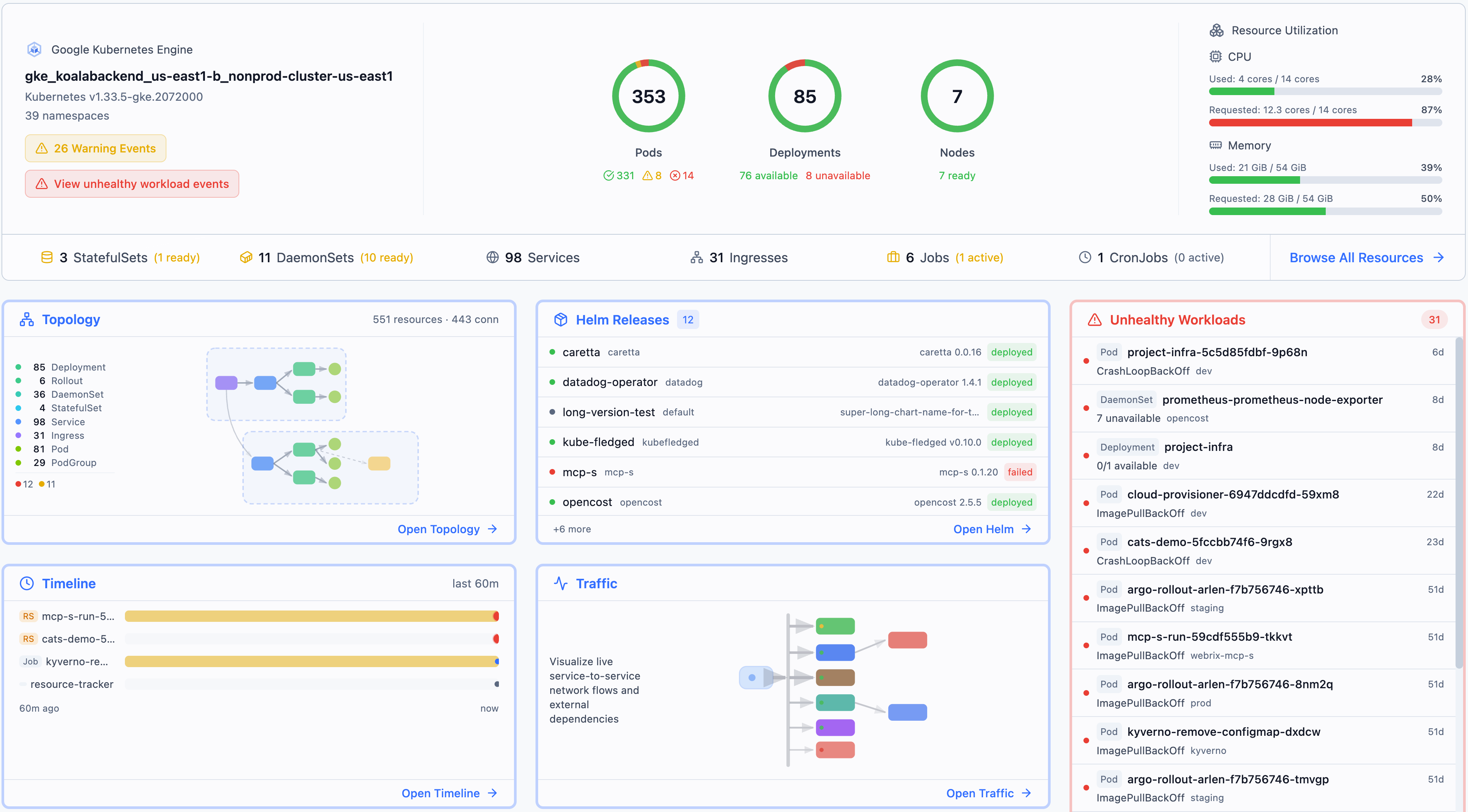
Cluster overview - topology, Helm, timeline, traffic, and unhealthy workloads at a glance.
- Radar OSS - the binary, on your machine or in your cluster. Apache 2.0. Every feature in these docs ships in OSS - nothing gated behind a paid tier.
- Radar Cloud - the same binary still runs in each of your clusters, but dials out to a hosted control plane that gives your team a single URL across every cluster, with SSO, RBAC, audit log, billing, and fleet views.
Pick your path
Install Radar locally
Run the binary against any cluster reachable from your kubeconfig. No account, no cloud, nothing to install in your cluster.
Quickstart with Cloud
Sign up, install the Helm chart, connect a cluster, and share fleet views with your team.
OSS vs Cloud
What each surface gives you, side by side - so you pick the right one the first time.
AI via MCP
Wire Radar into Claude, Cursor, Claude Code, and other MCP-aware tools.
Explore by area
Features
Topology, timeline, audit, upgrade impact, access control, image filesystem, Helm, GitOps, traffic, cost, MCP.
Self-hosted
CLI flags, config files, in-cluster Helm, authentication, integrations.
Cloud
Organizations, roles, SSO, PATs, billing, audit log, fleet views.
API reference
The HTTP surface the UI uses, area by area, with notes on Cloud-tunnel access.
Keyboard shortcuts
Every keybinding in the Radar UI - identical between OSS and Cloud.
Source code
The engine, in-cluster pod, and React UI library - all Apache 2.0.