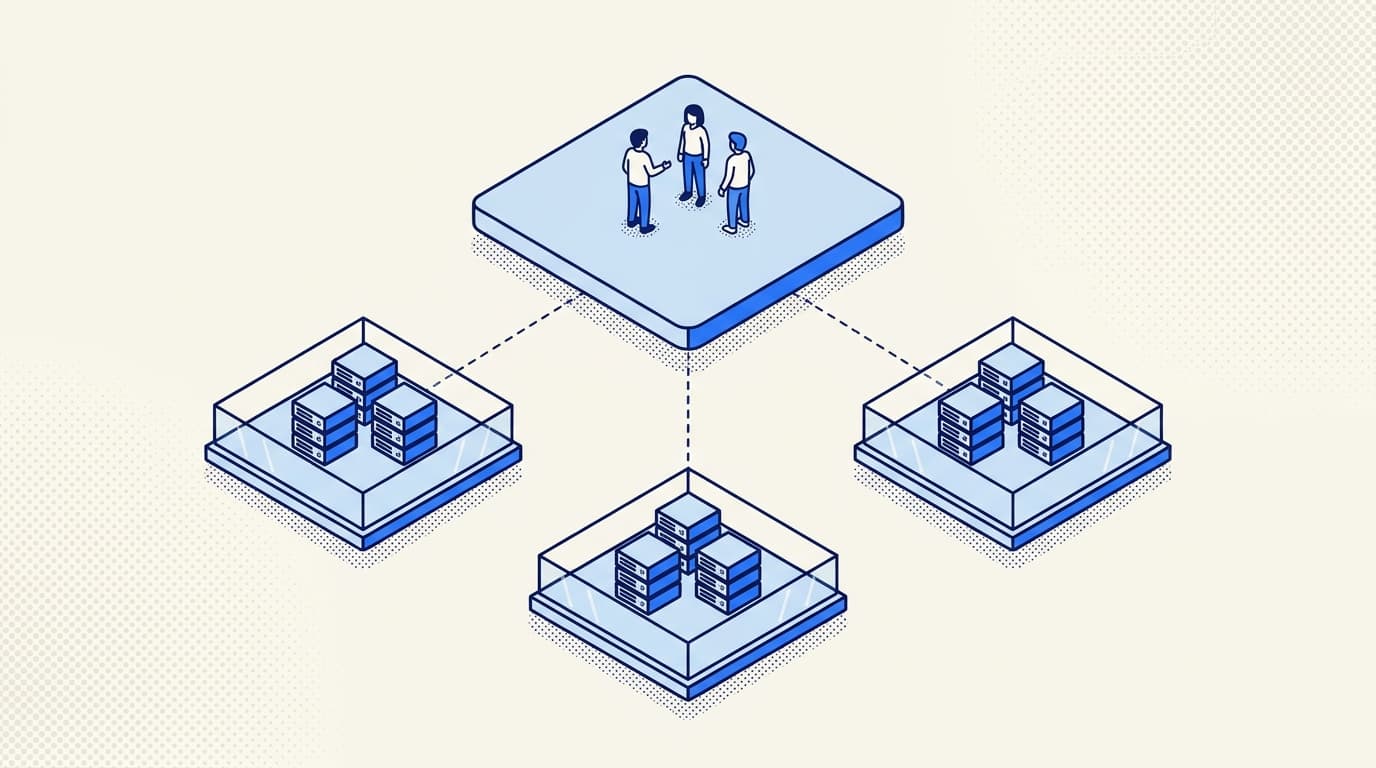
If your team runs Kubernetes for other companies, as an MSP, an integrator, or a vendor whose software runs in each customer's cluster, Radar Cloud can now give each of your customers an organization of its own, under yours. We call them sub-organizations, and they're live as of November 5, 2026.
Each customer gets its own clusters, members, alerts and audit log. Your team moves between customers from one menu, your customers can sign in and see only their own clusters, and everything runs on your plan, with one bill.
Every customer is one click away
Working on a customer's clusters means picking that customer from the organization menu. Everything on screen then belongs to them: their clusters, their Issues queue, their alerts. Once you have more than eight organizations, the menu adds a search box.
Adding a customer takes a name and, if you want, their admin's email. The admin gets an invitation to own the new organization. If you're the one installing Radar for them, add yourself as an owner and hand it over when they're ready. Then you connect their clusters the same way you connect any cluster, from inside their organization.
Your organization keeps the list of customers, who owns each one, and how many clusters each has.
One customer's problems, and nobody else's
When something breaks at Acme, Acme's Issues queue shows Acme's problems and nothing else. Here it's a crash loop in payments-api on acme-prod and an image pull failure on acme-staging.
Acme's alert rules live in Acme's organization too, so Acme's alerts can go to Acme's own Slack channel without touching any other customer.
Your customers can sign in
A customer's team signs in to their own organization and sees only their own clusters. Each customer gets its own sign-in page ("Sign in to Acme"), can require its own SSO, and manages its own members.
They also decide how much of your team gets in. When you create a customer, you choose whether everyone on your team gets access or only the people you add. After that, the customer's owners hold that switch. And once a customer has an owner, your team can't make itself one.
Billing stays with you. The customer's billing page says their plan is managed by you, and there's nothing for them to buy.
If you'd rather your customers see your brand than ours, white-labeling is available: your customers can see a different name and logo instead of Radar's.
Removing someone removes them everywhere
Offboarding follows the same structure. Remove someone from your organization and they lose access to every customer organization too, however they got in, including invitations a customer sent them directly.
When one organization is still the right call
If your customers never sign in and your team runs everything as one fleet with one on-call rotation, you may not need sub-organizations at all. Tag each cluster with the customer's name, and the Clusters page search narrows the list to that customer.
| One organization | Sub-organization per customer | |
|---|---|---|
| Customers sign in | No, they would see the others | Yes, to their own organization, with their own SSO |
| Alert rules | All in your organization | Each customer has its own |
| Audit log | One for everyone | One per customer |
| Your team's access | Everyone sees every customer | Your whole team, or only the people you add |
| Someone leaves your team | Remove them once | Remove them once, and every customer's access goes with it |
Hosted, Self-Managed and air-gapped
Sub-organizations run on Radar Cloud hosted by us. If a customer needs the control plane inside their own infrastructure, they can run Radar Cloud Self-Managed with a license issued from their organization, and its clusters still count on your bill. Fully air-gapped customers are on the Custom plan.
Getting started
Sub-organizations come with the Enterprise plan. For now, we switch them on for your organization ourselves, so book a call or email radar@skyhook.io. Once that's done, you create your first customer from Settings → Sub-organizations.
Get the next issue in your inbox
Kubernetes deep-dives, new Radar releases, and what we learned shipping them.
About one email a month. No sales sequences. Unsubscribe anytime.
Keep reading
SSO and RBAC Without Passing Around Kubeconfigs
A contractor needs read-only access to one staging cluster by Monday. Without SSO and scoped RBAC, that ticket bounces for a week. Here's how Radar Cloud collapses it.
Agents, UIs, and CLIs: The False Choice in Kubernetes Operations
Kubernetes ops spans three surfaces: CLI, UI, and AI agent. kubectl is fine, but a live cluster graph deserves better than raw YAML - for humans and agents alike.
The Fleet Visibility Gap: Why Teams With 5+ Clusters Hit a Wall
Every tool that worked at 2 clusters breaks at 8. kubectl, Lens, k9s, Headlamp are all single-cluster-at-a-time. Here's where the wall is and what it looks like.