KubeCon NA 2026: A Day 0 Hackathon and a Very Busy Booth
264 people built on Kubernetes at the Day 0 Cloud Native Hackathon in Salt Lake City, and 89 of 112 projects used Radar. What we learned, and what we heard at our booth.
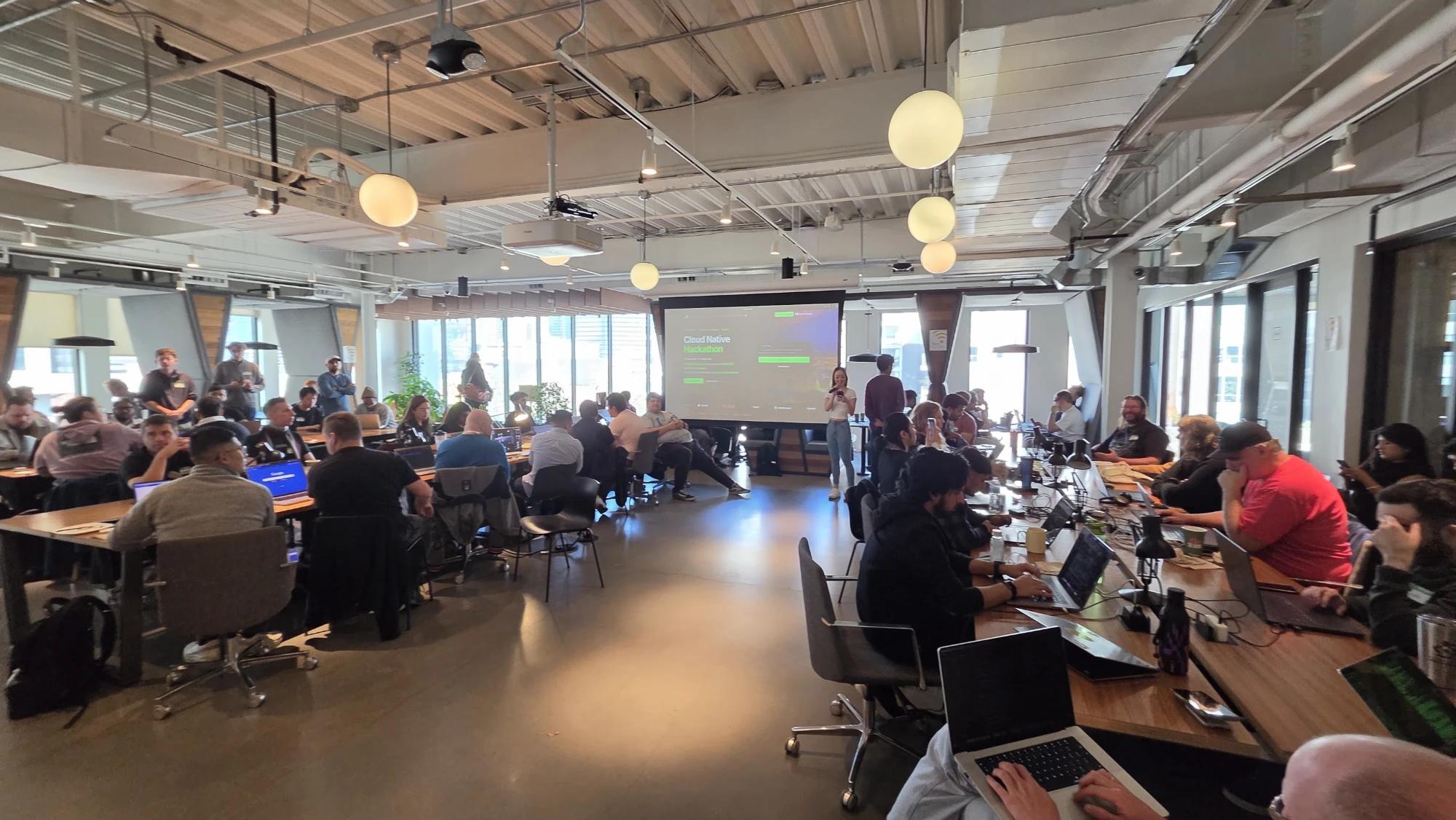
KubeCon NA 2026 in Salt Lake City was four days for us. On Monday, Day 0, we sponsored a track at the Cloud Native Hackathon run by Kunal Kushwaha and WeMakeDevs. Tuesday to Thursday we were at our booth on the show floor.
Both turned out bigger than we planned for.
The hackathon: 264 people, 112 projects, one day
Kunal's Cloud Native Hackathon ran on Monday, November 9, at The Shop Workspace in downtown Salt Lake City. The brief for every team was the same: build something that makes conferences better for the people who attend, speak at, sponsor or run them. Teams had one day, then demos in the evening.
The numbers, from Kunal's recap video and his summary for sponsors:
- 264 people checked in to build.
- 112 projects were submitted.
- 89 of them (79%) used Radar, including all six prize winners.
- 12 judges, among them Kelsey Hightower, Nadav (our CEO) and me.
Sonar, Dash0 and Elastic sponsored tracks alongside us, and a project could enter every track whose tool it used. Ours was called "Radar: AI SRE": run your project on Kubernetes with Radar connected, use Radar's UI and MCP server while you build, and use an AI investigation on a real issue or question.
A cluster for every team
We didn't make anyone bring a cluster. Each team could get its own: a virtual cluster on a shared EKS host, with Radar Cloud already connected, Argo CD, CloudNativePG and Prometheus installed, a starter repo, and a public URL for their app. Setup was one sentence to a coding agent, run inside a clone of the starter repo: "Get me set up for the hackathon. Our team is <name>."
54 projects ran on the clusters we provided and 21 on their own (the rest didn't say). The ones that brought their own used GKE, AKS, DigitalOcean, k3s on home lab machines, and plenty of kind clusters on laptops. One team ran 600 simulated KWOK nodes, one per conference talk.
How teams used Radar
Each write-up described how the project used Radar. Across the 89 projects that did (most used more than one):
| What they used | Projects |
|---|---|
| Radar's MCP server, from a coding agent | 61 |
| AI investigations | 53 |
| Checks (most with a before and after) | 53 |
| Argo CD and GitOps views | 52 |
| Logs | 26 |
| Creating Secrets in the Radar UI | 25 |
Many teams worked the same way: the agent wrote the code, pushed it, and then asked Radar whether the deploy actually worked. When it didn't, they ran an investigation. ConQuest traced real 503s to a readiness gap in their single-replica rollout, then found that a CPU limit was holding back the fix. Roloe, the best overall winner, learned from an investigation that its outage during deploys was a state problem, and moved its app state into Elasticsearch the same day. Pokémon Go for People was told not to add CPU or replicas but to fix how traffic was spread, and the team reported that was the right call.
The Radar track went to ConQuest, built by Jacob Bingham, Max Parry, Jake Nef and Daniel Nef, an app that makes going to conferences more fun. Max and Jake both wrote about the win on LinkedIn.
What we learned
Radar had to work for both ends of the room. Plenty of platform, DevOps and SRE engineers came, and they sat next to app developers, students, founders and AI engineers, plus at least one product manager who, Kunal wrote, had never written code before that day. Many of the people who run Kubernetes for a living brought their own clusters and connected Radar to them. For the first-time builders, Radar was their way into Kubernetes: several teams said it meant they didn't have to learn kubectl to ship.
Most projects used Radar through an agent. 61 of the 89 used Radar's MCP server from Claude Code, Codex or another agent. The most common complaint was agent-side too: signing in to the MCP server and picking the right org, not anything in the UI.
Radar isn't something your app calls. We asked teams to show what Radar did for their project, not to break things on purpose, and one participant described the moment that clicked. Srihari Nagaram, a staff platform engineer, wrote on LinkedIn that he first treated Radar like an API his app should call, then realized it was "how you ship and operate". Next time, that's how we'll frame it from the first slide.
The feedback we got
47 teams left explicit feedback in their write-ups. These came up more than once:
- Make MCP sign-in easier for headless agents. Agents that run unattended need a clearer setup path than interactive sign-in, and it should be obvious which org an MCP connection is using.
- Start an investigation from a question. Radar Cloud investigations start from a resource. People wanted to ask "why is this slow under load?" directly, the way local Radar already can.
- Let me mark a Checks finding as intended, with a reason, and keep Checks history so a before and after doesn't need screenshots.
- Tell GitOps deploys apart from manual changes. An image bump from Argo CD shouldn't read like someone troubleshooting.
- Make "disconnected" look different from "healthy" or "empty". A cluster that stopped reporting should be obvious at a glance.
- Show "is my new version live?" at a glance, right after a push.
And what people liked, paraphrased from the write-ups: MCP tools that return answers instead of raw dumps; knowing whether a deploy worked; no kubectl and no cluster keys inside the agent; and seeing several clusters in one place.
All of these are on our list.
The booth
Then the show floor opened, and we were overwhelmed, in the best way. So many of the people who came by already used Radar. Some had replaced Rancher or Headlamp with it, some had found it through a Reddit thread or a friend, and they told us how much they love it. Hearing that in person, again and again, from people we had never met, never got old.
The demo on the screen was "Break our cluster. Watch Radar find it.": scan a QR code, pick something to break, and watch Radar's AI investigation find the cause. But most conversations went past the demo and into what people need. The themes we heard again and again:
- Give developers a view without giving them the cluster. Many teams want their developers to see their own workloads and logs without kubectl access or a kubeconfig, and some want that for developers who would rather not learn Kubernetes tooling at all.
- All clusters in one place. Fleets ranged from a handful of clusters to very large ones, and the bigger the fleet, the more a single view mattered.
- Security constraints on AI. Some teams can't send cluster data to a hosted model, or can only use one approved agent. They asked about self-hosting, bringing their own model key, and how Radar's MCP server limits what an agent can do.
- Their own resources, their own way. Custom topology relationships for internal CRDs, per-app views, and grouping apps by team.
- Clusters that come and go. Platforms that create clusters automatically want stale ones cleaned up, not piling up in the UI.
We came home with a long list of follow-ups and a clearer picture of what to build next. If we talked at the booth, expect to hear from us.
Thank you
Thank you to Kunal and the WeMakeDevs team for a Day 0 event that put builders first, to Kelsey Hightower and my fellow judges for spending the day with the teams, and to every team that built something with Radar. And thank you to everyone who stopped by our booth to say you use Radar. It meant a lot.
If you missed us in Salt Lake City, Radar is open source (Apache-2.0). brew install skyhook-io/tap/radar and point it at your cluster, or connect your clusters to Radar Cloud on the free plan. And if it's useful, a star on GitHub helps a small team a lot.
Get the next issue in your inbox
Kubernetes deep-dives, new Radar releases, and what we learned shipping them.
About one email a month. No sales sequences. Unsubscribe anytime.
Questions about this post?Ask in #radar-help on the Radar Slack
Keep reading
Radar at 4,000 Stars: Come Say Hello at KubeCon
Radar passed 4,000 GitHub stars, and thousands of engineers now use it every day. Next week we get to meet some of them at KubeCon NA 2026, booth 365.
Radar on Cloud Native FM: Kubernetes as a Graph, and What Agents Change
Nadav Erell took Radar through a live broken cluster on Cloud Native FM. The short version: why a cluster is a graph, and what MCP actually changes.
Read-Only Is Not a Safety Boundary
Two sentences get said in every meeting where a team wires an AI agent into a cluster: it's read-only, and just use the service account. Both are wrong later.