> ## Documentation Index
> Fetch the complete documentation index at: https://radarhq.io/docs/llms.txt
> Use this file to discover all available pages before exploring further.
# Radar documentation
> Install and operate Radar - the open-source Kubernetes visibility tool, and Radar Cloud, the hosted multi-cluster control plane.
Visibility into Kubernetes clusters: topology, events, resources, Helm, GitOps, traffic, cost, audit, access control, and an MCP server for AI tools - all from a single binary, with no sidecars to install.
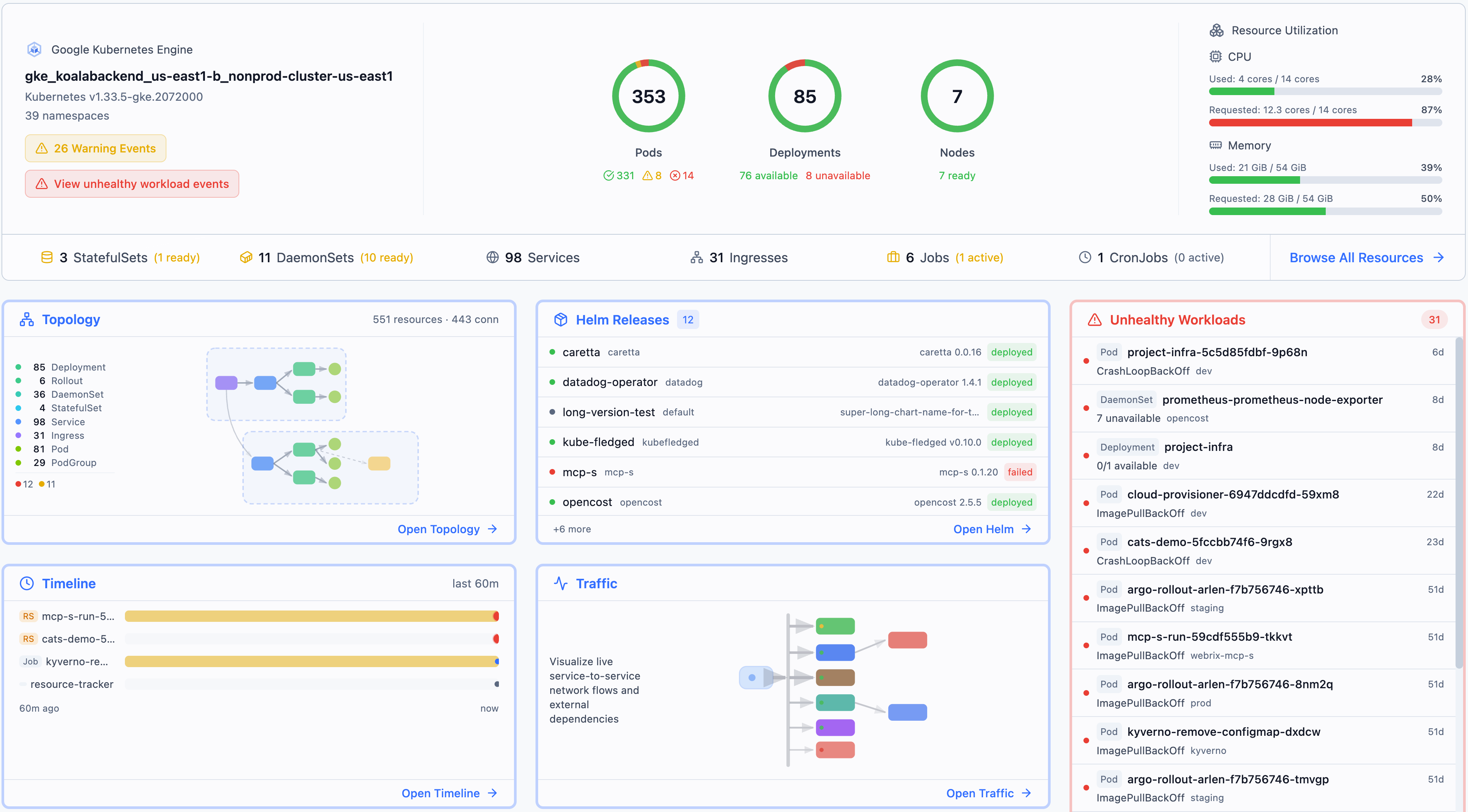 Two ways to run it:
* **Radar OSS** - the binary, on your machine or in your cluster. Apache 2.0. **Every feature in these docs ships in OSS** - nothing gated behind a paid tier.
* **Radar Cloud** - the same binary still runs in each of your clusters, but dials out to a hosted control plane that gives your team a single URL across every cluster, with SSO, RBAC, audit log, billing, and fleet views.
## Pick your path
Run the binary against any cluster reachable from your kubeconfig. No account, no cloud, nothing to install in your cluster.
Sign up, install the Helm chart, connect a cluster, and share fleet views with your team.
What each surface gives you, side by side - so you pick the right one the first time.
Wire Radar into Claude, Cursor, Claude Code, and other MCP-aware tools.
## Explore by area
Topology, timeline, audit, access control, image filesystem, Helm, GitOps, traffic, cost, MCP.
CLI flags, config files, in-cluster Helm, authentication, integrations.
Organizations, roles, SSO, PATs, billing, audit log, fleet views.
The HTTP surface the UI uses, area by area, with notes on Cloud-tunnel access.
Every keybinding in the Radar UI - identical between OSS and Cloud.
The engine, in-cluster pod, and React UI library - all Apache 2.0.
Radar is open source. Issues, PRs, and integration requests are welcome at [github.com/skyhook-io/radar](https://github.com/skyhook-io/radar).
Two ways to run it:
* **Radar OSS** - the binary, on your machine or in your cluster. Apache 2.0. **Every feature in these docs ships in OSS** - nothing gated behind a paid tier.
* **Radar Cloud** - the same binary still runs in each of your clusters, but dials out to a hosted control plane that gives your team a single URL across every cluster, with SSO, RBAC, audit log, billing, and fleet views.
## Pick your path
Run the binary against any cluster reachable from your kubeconfig. No account, no cloud, nothing to install in your cluster.
Sign up, install the Helm chart, connect a cluster, and share fleet views with your team.
What each surface gives you, side by side - so you pick the right one the first time.
Wire Radar into Claude, Cursor, Claude Code, and other MCP-aware tools.
## Explore by area
Topology, timeline, audit, access control, image filesystem, Helm, GitOps, traffic, cost, MCP.
CLI flags, config files, in-cluster Helm, authentication, integrations.
Organizations, roles, SSO, PATs, billing, audit log, fleet views.
The HTTP surface the UI uses, area by area, with notes on Cloud-tunnel access.
Every keybinding in the Radar UI - identical between OSS and Cloud.
The engine, in-cluster pod, and React UI library - all Apache 2.0.
Radar is open source. Issues, PRs, and integration requests are welcome at [github.com/skyhook-io/radar](https://github.com/skyhook-io/radar).