> ## Documentation Index
> Fetch the complete documentation index at: https://radarhq.io/docs/llms.txt
> Use this file to discover all available pages before exploring further.
# Cluster API (CAPI) cluster lifecycle visibility
> Visualize Cluster API in Radar: the full CAPI ownership chain from ClusterClass through Cluster and Machine to Node, with MachineHealthChecks and lifecycle status.
[Cluster API](https://cluster-api.sigs.k8s.io/) is the Kubernetes sub-project for declarative cluster lifecycle management. Used by platform teams to provision and manage workload clusters.
### What Radar Shows
**Topology:** Full CAPI ownership chain - ClusterClass → Cluster → KubeadmControlPlane → Machine → Node, and Cluster → MachineDeployment → MachineSet → Machine → Node. MachineHealthCheck → Cluster protection edges. Machine → Node edges use status.nodeRef (semantic, not owner-ref).
**Cluster Detail View:**
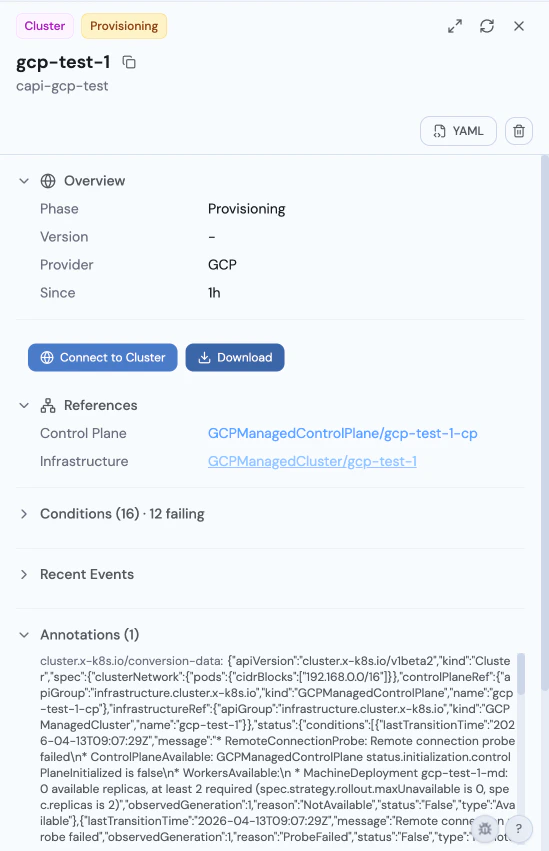
* Phase, version, cluster class, control plane endpoint
* Control plane and worker replica counts (v1beta2-aware)
* Control plane and infrastructure references (clickable)
* ClusterClass topology section (worker MachineDeployments table)
* "Connect to Cluster" button - auto-connects Radar to the workload cluster
* "Download Kubeconfig" button
* Conditions
**Machine Detail View:**
* Phase, role (Control Plane / Worker), version, provider ID
* Clickable Node reference (via status.nodeRef)
* Addresses table, node info (OS, architecture, kernel, kubelet)
* Bootstrap and infrastructure references
**MachineDeployment Detail View:**
* Phase, replicas (desired/ready/available/up-to-date), strategy
* Version, cluster name
* Machine template references
* Owned machines label hint (copyable)
**KubeadmControlPlane Detail View:**
* Replicas, version, initialized status (v1beta2-aware)
* Machine template with drain/volume detach/deletion timeouts
* Kubeadm config highlights (cert SANs)
* Last remediation info
* Owned machines label hint
**ClusterClass Detail View:**
* Infrastructure, control plane, worker topology tables
* Variables with schema types
* Patches with definitions and enabledIf expressions
**MachineHealthCheck Detail View:**
* Expected/healthy machine counts, remediations allowed
* Label selector display
* Unhealthy conditions tables (v1beta1 + v1beta2 formats)
* Remediation template
**Additional renderers:** MachineSet, MachinePool, MachineDrainRule, KubeadmConfig/Template
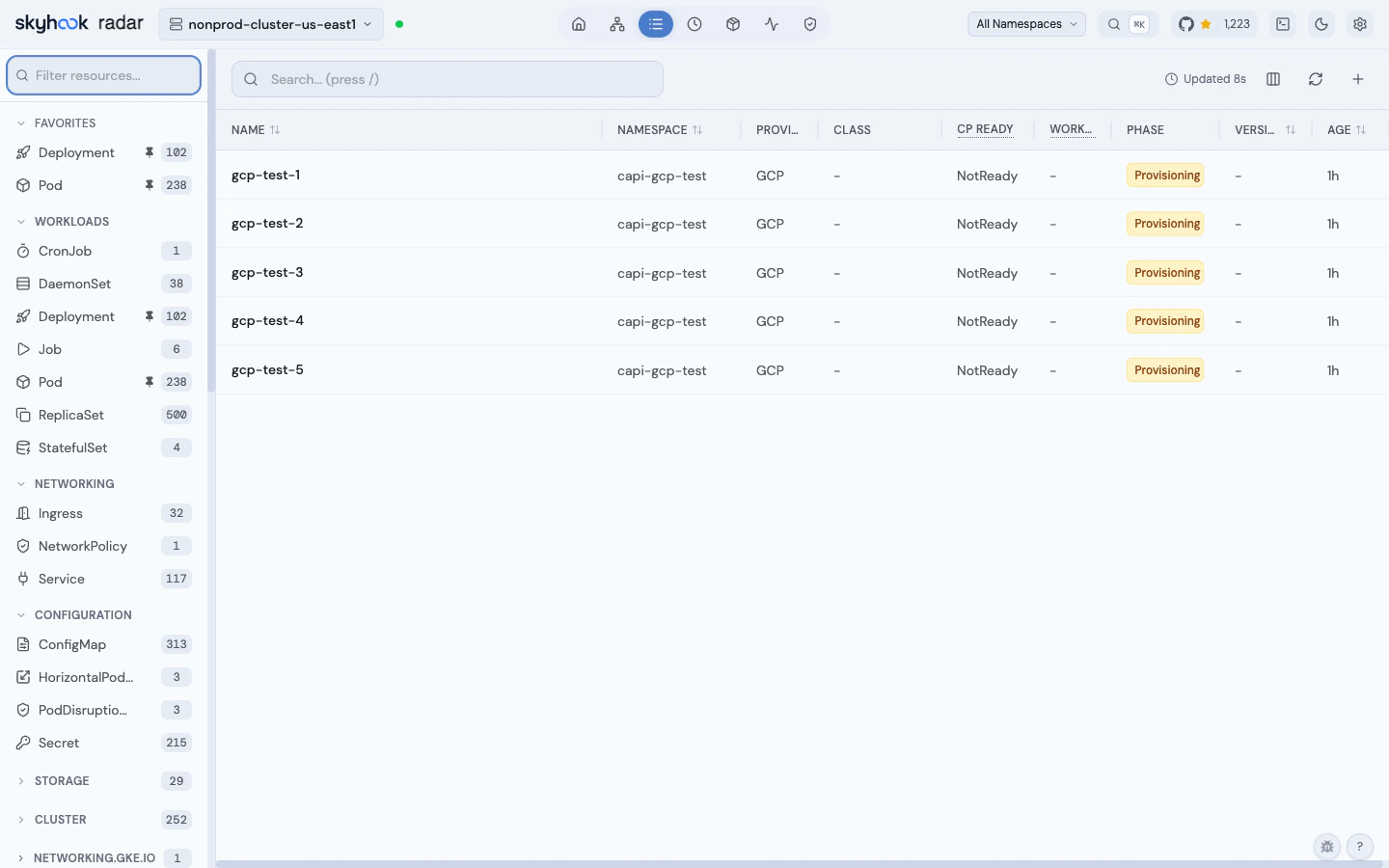
**Resource Browser:** Smart columns for all CAPI kinds - phase badges, replica counts, cluster names, roles, versions.
**Topology-controlled badge:** Resources managed by ClusterClass (label `topology.cluster.x-k8s.io/owned`) show a warning banner.
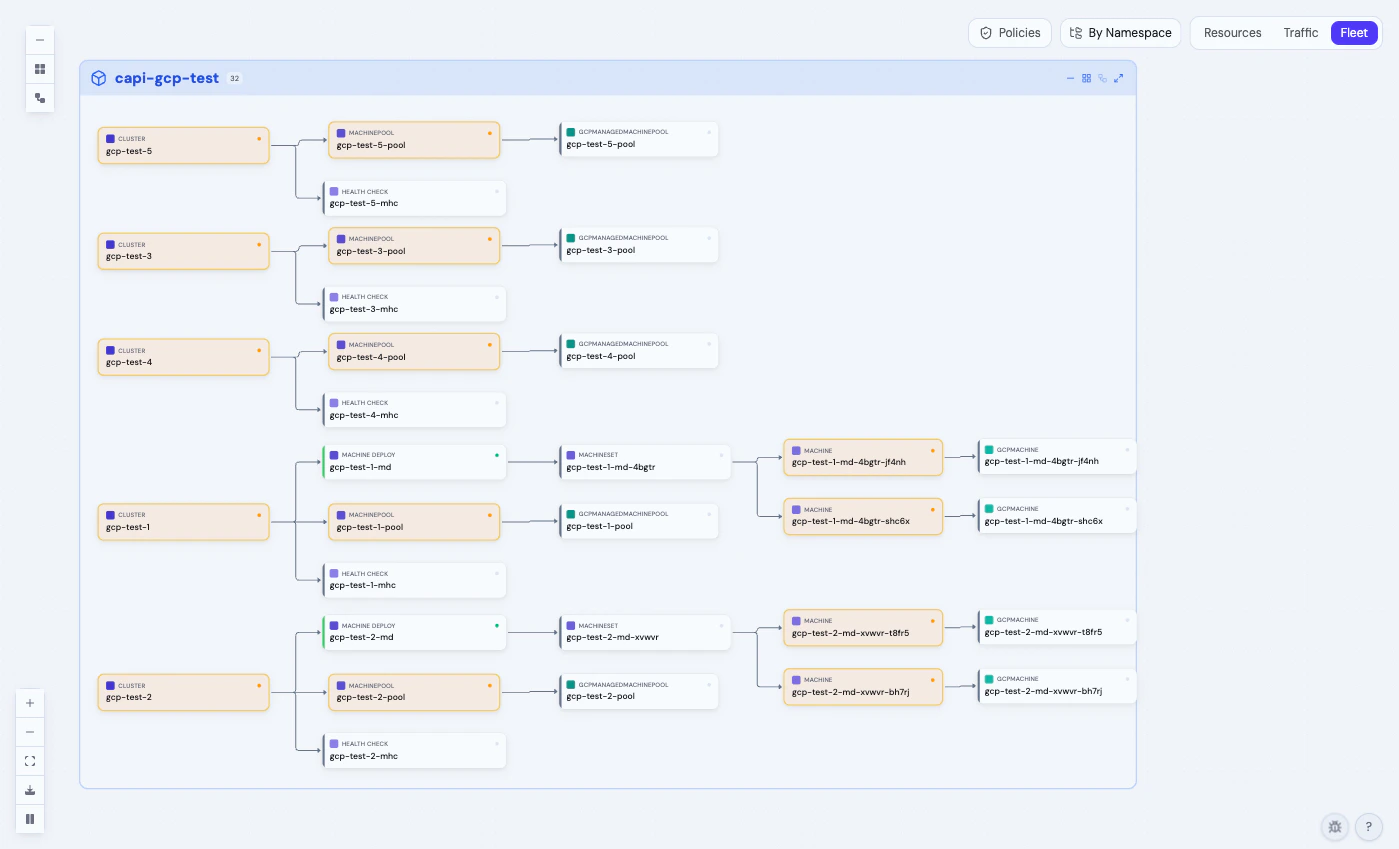
**Fleet topology mode:** Dedicated "Fleet" view filters to CAPI and infrastructure provider resources only, giving a clean cluster-management view without application workload noise. Groups start expanded by default.
 **Resource browser** with smart columns per CAPI kind - Provider detection, phase badges, replica counts:
 **Cluster detail view** with Connect to Cluster and Download Kubeconfig actions, provider detection, and clickable references to infrastructure resources:
 ### Infrastructure Provider Renderers
Radar has first-class renderers for **AWS (CAPA)**, **GCP (CAPG)**, and **Azure (CAPZ)** infrastructure provider resources. These surface provider-specific operational data - instance types, scaling config, VPC/subnet topology, managed service addons - that would otherwise be buried in raw YAML.
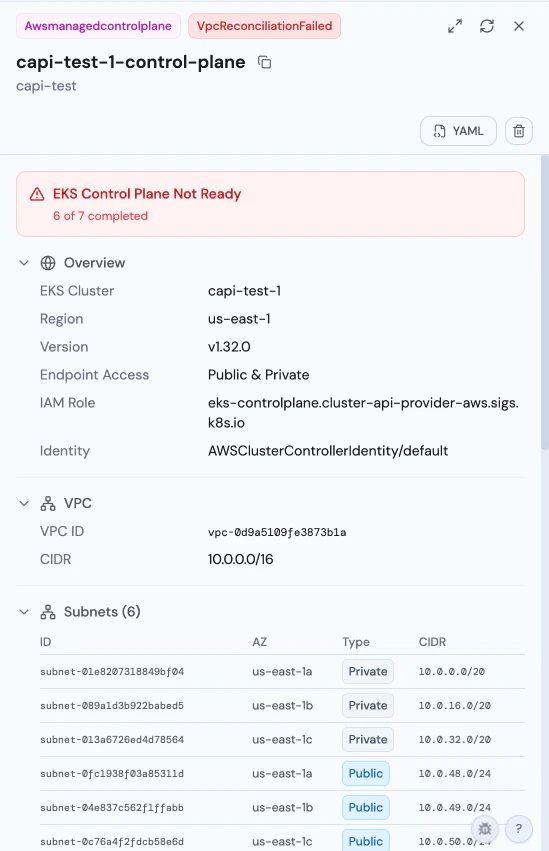
**AWS EKS control plane** - VPC topology with subnets (Public/Private badges), security groups, EKS addons, IAM roles:
### Infrastructure Provider Renderers
Radar has first-class renderers for **AWS (CAPA)**, **GCP (CAPG)**, and **Azure (CAPZ)** infrastructure provider resources. These surface provider-specific operational data - instance types, scaling config, VPC/subnet topology, managed service addons - that would otherwise be buried in raw YAML.
**AWS EKS control plane** - VPC topology with subnets (Public/Private badges), security groups, EKS addons, IAM roles:
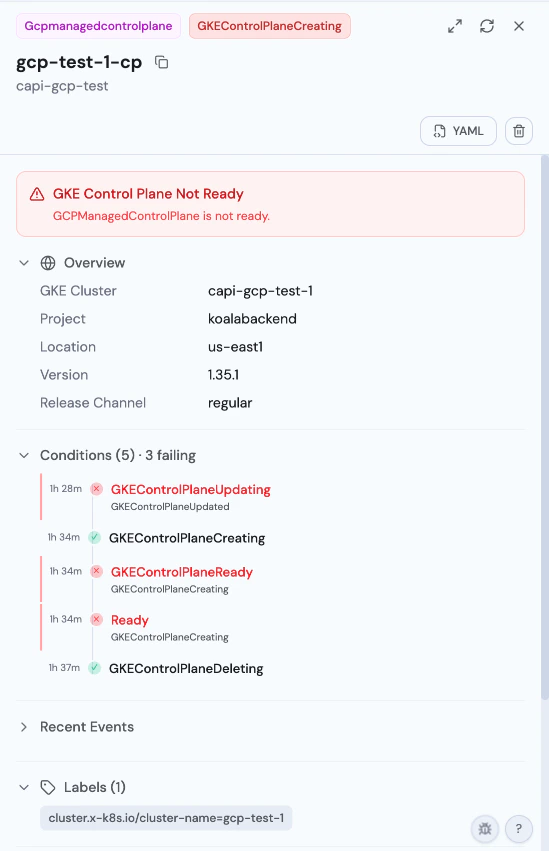
 **GCP GKE control plane** - project, location, release channel, and conditions timeline with left-aligned timestamps:
 **Managed machine pools**: Instance/VM types, scaling config (autoscaling min/max), capacity type badges (On-Demand/Spot), node management (auto-repair/upgrade), labels and taints.
**Azure AKS**: Location, resource group, SKU tier, network plugin/policy, System/User mode badges, Regular/Spot priority, availability zones.
**Individual machines**: Instance type/state badges, provider IDs, addresses, conditions.
**Templates and cluster stubs**: Lightweight renderers for instance templates (with resolved capacity) and cluster infrastructure stubs (endpoint + failure domains).
### Supported CRDs
| CRD | Group | Topology | Detail View | AI Summary |
| --------------------------- | --------------------------------- | -------- | ----------- | ---------- |
| Cluster | `cluster.x-k8s.io` | Yes | Yes | Yes |
| ClusterClass | `cluster.x-k8s.io` | Yes | Yes | Yes |
| Machine | `cluster.x-k8s.io` | Yes | Yes | Yes |
| MachineSet | `cluster.x-k8s.io` | Yes | Yes | Yes |
| MachineDeployment | `cluster.x-k8s.io` | Yes | Yes | Yes |
| MachinePool | `cluster.x-k8s.io` | Yes | Yes | Yes |
| MachineHealthCheck | `cluster.x-k8s.io` | Yes | Yes | Yes |
| MachineDrainRule | `cluster.x-k8s.io` | No | Yes | No |
| KubeadmControlPlane | `controlplane.cluster.x-k8s.io` | Yes | Yes | Yes |
| KubeadmControlPlaneTemplate | `controlplane.cluster.x-k8s.io` | No | Generic | No |
| KubeadmConfig | `bootstrap.cluster.x-k8s.io` | No | Yes | No |
| KubeadmConfigTemplate | `bootstrap.cluster.x-k8s.io` | No | Generic | No |
| AWSManagedControlPlane | `controlplane.cluster.x-k8s.io` | Yes | Yes | No |
| AWSManagedMachinePool | `infrastructure.cluster.x-k8s.io` | Yes | Yes | No |
| AWSMachine | `infrastructure.cluster.x-k8s.io` | Yes | Yes | No |
| AWSMachineTemplate | `infrastructure.cluster.x-k8s.io` | No | Yes | No |
| AWSManagedCluster | `infrastructure.cluster.x-k8s.io` | No | Yes | No |
**Managed machine pools**: Instance/VM types, scaling config (autoscaling min/max), capacity type badges (On-Demand/Spot), node management (auto-repair/upgrade), labels and taints.
**Azure AKS**: Location, resource group, SKU tier, network plugin/policy, System/User mode badges, Regular/Spot priority, availability zones.
**Individual machines**: Instance type/state badges, provider IDs, addresses, conditions.
**Templates and cluster stubs**: Lightweight renderers for instance templates (with resolved capacity) and cluster infrastructure stubs (endpoint + failure domains).
### Supported CRDs
| CRD | Group | Topology | Detail View | AI Summary |
| --------------------------- | --------------------------------- | -------- | ----------- | ---------- |
| Cluster | `cluster.x-k8s.io` | Yes | Yes | Yes |
| ClusterClass | `cluster.x-k8s.io` | Yes | Yes | Yes |
| Machine | `cluster.x-k8s.io` | Yes | Yes | Yes |
| MachineSet | `cluster.x-k8s.io` | Yes | Yes | Yes |
| MachineDeployment | `cluster.x-k8s.io` | Yes | Yes | Yes |
| MachinePool | `cluster.x-k8s.io` | Yes | Yes | Yes |
| MachineHealthCheck | `cluster.x-k8s.io` | Yes | Yes | Yes |
| MachineDrainRule | `cluster.x-k8s.io` | No | Yes | No |
| KubeadmControlPlane | `controlplane.cluster.x-k8s.io` | Yes | Yes | Yes |
| KubeadmControlPlaneTemplate | `controlplane.cluster.x-k8s.io` | No | Generic | No |
| KubeadmConfig | `bootstrap.cluster.x-k8s.io` | No | Yes | No |
| KubeadmConfigTemplate | `bootstrap.cluster.x-k8s.io` | No | Generic | No |
| AWSManagedControlPlane | `controlplane.cluster.x-k8s.io` | Yes | Yes | No |
| AWSManagedMachinePool | `infrastructure.cluster.x-k8s.io` | Yes | Yes | No |
| AWSMachine | `infrastructure.cluster.x-k8s.io` | Yes | Yes | No |
| AWSMachineTemplate | `infrastructure.cluster.x-k8s.io` | No | Yes | No |
| AWSManagedCluster | `infrastructure.cluster.x-k8s.io` | No | Yes | No |